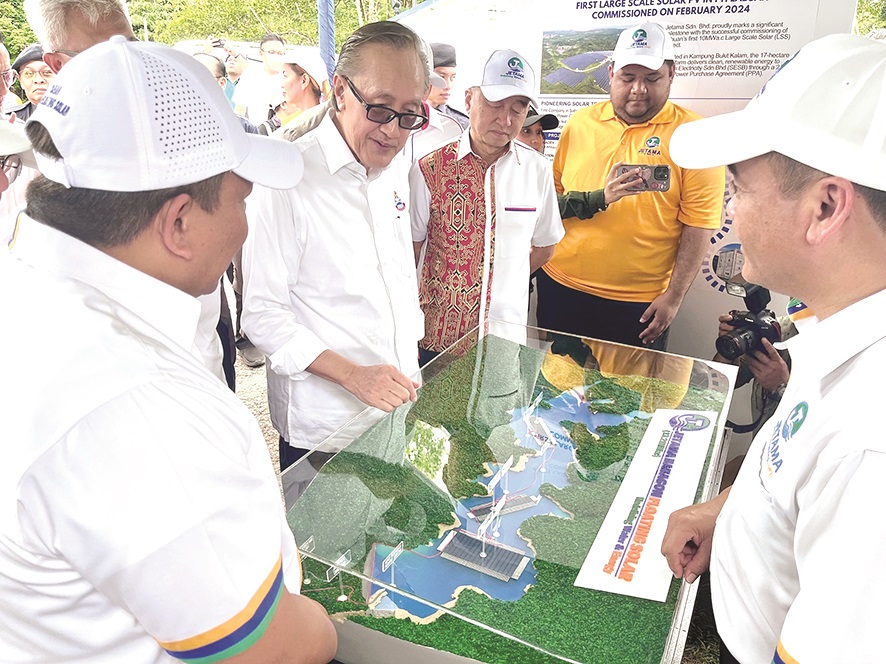
PENAMPANG: Jetama Sdn Bhd on Wednesday launched two major solar projects in Sabah – a 13.21MWac floating solar PV system at Babagon Dam here and a 15MWac solar PV farm in Batu Sapi, Sandakan.
The projects aim to strengthen the State’s electricity supply through renewable energy.
Deputy Chief Minister II cum Finance Minister Datuk Seri Masidi Manjun, who officiated the launches at Babagon Dam, said the two projects together would add 28MWac of new power generation capacity, helping to stabilise electricity supply in Sabah.
“I am particularly pleased that one is on the East Coast in Batu Sapi, an area previously identified with power supply challenges,” he told a press conference Wednesday.
Masidi said the projects differ in cost and technical complexity, with Batu Sapi estimated at RM53 million and the floating system at Babagon at RM63 million due to the additional construction challenges associated with building on water.
He emphasised the importance of good management and governance to ensure long-term sustainability.
“The profit from 13.2MW or 15MW of power may not be large, but effective management ensures sustainability, safeguards staff welfare and allows for future expansion,” he said.
Masidi also stressed that the initiatives aim to transform the work culture of government-linked companies to operate like private enterprises focused on efficiency and profitability.
Reassuring local communities, he confirmed the projects would not compromise water safety.
“For villagers, although the solar installations are on water, they will not affect drinking water. I guarantee it is safe,” he said. With these additions, including a 10MWac solar farm in Labuan, Sabah’s total solar capacity through Jetama now reaches 38.2MW.
Masidi urged all stakeholders to prioritise transparent management, profitability and sustainability to ensure the benefits of renewable energy reach all Sabahans.
He said the State Government also encourages exploration of other potential areas for solar development, subject to detailed studies on environmental impact, site suitability, safety and implementation costs.
Meanwhile, Jetama CEO Datuk Ahmad Naim Uddang said the launch of the two solar projects marked a significant milestone, demonstrating the State’s capability, through government-linked companies (GLCs) and local industry partners, to lead in renewable energy innovation.
“This is while addressing the State’s needs, prioritising the welfare of its people and ensuring sustainable energy resources.
“This is also what Jetama aims to achieve through our slogan, ‘Redefining Water and Energy’ – to redefine the role of water and energy in a smarter, more integrated and sustainable manner for the future generations of Sabah,” he said.
Ahmad Naim said the floating solar project at Babagon Dam strategically utilises the reservoir’s 220-acre water surface for power generation, with the solar array covering 40 acres or 20 per cent of the reservoir.
The project is the first in Malaysia to implement the concept of “floating solar on potable water,” differing from conventional installations that are usually set up on abandoned quarries, lakes or hydro dams.
According to him, Jetama has signed Power Purchase Agreements (PPAs) with Sabah Electricity Sdn Bhd through the consortia Jetama Babagon Floating Solar Sdn Bhd and Jetama Batu Sapi Solar Sdn Bhd on Aug 20 and Oct 27, 2025. With capacities of 13.21MWac at Babagon and 15MWac at Batu Sapi, Jetama’s total new energy addition is 28.21MWac.
Combined with its large-scale solar farm in Labuan with a capacity of 10MWac, Jetama’s overall solar generation capacity now totals 38.21MWac.
Ahmad Naim emphasised that the projects align with Malaysia’s national commitment to achieving net-zero greenhouse gas emissions by 2050 under the National Energy Transition Roadmap (NETR) and the New Industrial Master Plan 2030.
The initiatives also support the Sabah Maju Jaya agenda and the Sabah Energy Roadmap and Master Plan 2040 (Se-Ramp 2040), in line with the United Nations Sustainable Development Goals (SDGs), particularly SDG7, SDG9 and SDG13.
He expressed gratitude to strategic partners and project supporters, including Sabah Development Bank Berhad, Ambank Malaysia Berhad, Sabah Electricity, Energy Commission of Sabah, the Sabah Energy Council, Jesselton Solar Service Sdn Bhd, Evolute Asia Sdn Bhd, Silabumi Sdn Bhd, the Sabah Water Department and the Sabah Irrigation and Drainage Department.
“The Babagon floating solar project can serve as an excellent model of how positive synergy among all stakeholders, whether GLCs or government agencies, can drive development that benefits both the people and Sabah,” he said.