


Advertisement
 As part of these reforms, new pre-qualification requirements have been introduced before a company is eligible to apply for a prospecting licence.
SPONSORED CONTENT
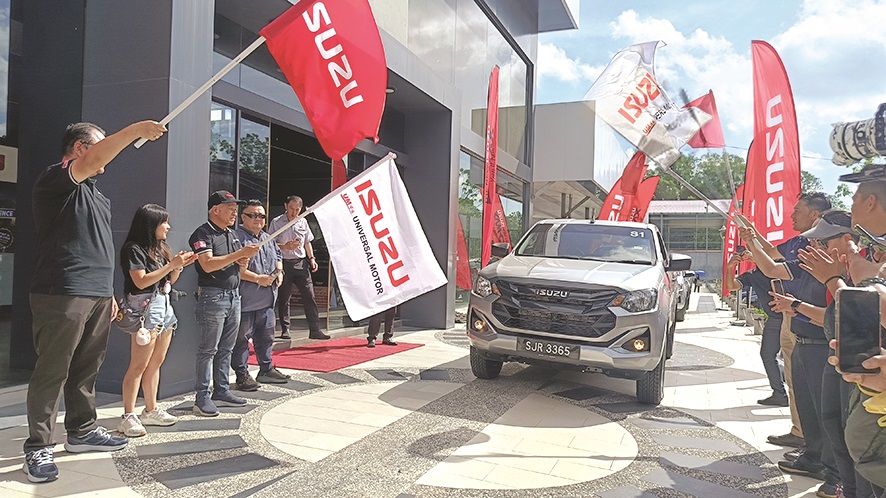
The 2026 D-MAX also introduces an 8-speed automatic gearbox with sequential shift across the range, including the Single Cab variant, making it the first pick-up truck in Malaysia to offer an automatic transmission in that body style.
Advertisement
 Mineral prospecting involves substantial costs and commercial risk, borne entirely by the applicants. This includes geological work, environmental assessments, technical studies and compliance obligations, often running into millions of ringgits with no guarantee of success.
Advertisement
 According to SMM Chief Executive Officer (CEO) Natasha Sim, who briefed Sabah Publishing House Deputy General Manager Dexter Yeh during a courtesy call at the SMM office in Plaza Shell, only 30% of Sabah has been comprehensively mapped for its mineral deposits by the Department of Mineral and Geoscience Sabah (JMG).
Incoming prospecting activities thus present an important opportunity for the State to expand its mineral data.
Under the current development model overseen by SMM, the State bears no financial cost or liability throughout the prospecting phase, while securing full ownership of all mineral data generated.
This is especially significant given that only about 30% of Sabah’s land area has been previously explored mainly by the federal Department of Minerals and Geoscience (JMG) and even then, the State does not own that data.
According to SMM Chief Executive Officer (CEO) Natasha Sim, who briefed Sabah Publishing House Deputy General Manager Dexter Yeh during a courtesy call at the SMM office in Plaza Shell, only 30% of Sabah has been comprehensively mapped for its mineral deposits by the Department of Mineral and Geoscience Sabah (JMG).
Incoming prospecting activities thus present an important opportunity for the State to expand its mineral data.
Under the current development model overseen by SMM, the State bears no financial cost or liability throughout the prospecting phase, while securing full ownership of all mineral data generated.
This is especially significant given that only about 30% of Sabah’s land area has been previously explored mainly by the federal Department of Minerals and Geoscience (JMG) and even then, the State does not own that data.
 The current licensing process is therefore a strategic pathway for Sabah to reclaim ownership of its geological data, expand knowledge of its mineral potential, and systematically explore the remaining 70% of land area for which little or no information currently exists.
While the State bears no cost during prospecting, it becomes directly involved at the mining stage. If and when a mining lease is approved, the State participates through royalties, fees, land-use payments, and in some cases, equity participation.
This ensures that the commercial benefits of resource extraction flow back to the people of Sabah but only once all necessary diligence, safeguards, and approvals have been completed.
The current licensing process is therefore a strategic pathway for Sabah to reclaim ownership of its geological data, expand knowledge of its mineral potential, and systematically explore the remaining 70% of land area for which little or no information currently exists.
While the State bears no cost during prospecting, it becomes directly involved at the mining stage. If and when a mining lease is approved, the State participates through royalties, fees, land-use payments, and in some cases, equity participation.
This ensures that the commercial benefits of resource extraction flow back to the people of Sabah but only once all necessary diligence, safeguards, and approvals have been completed.


