Advertisement
Advertisement
Advertisement
 This increase in acidity is unequivocally due to the oceans’ absorption of excess carbon dioxide from the atmosphere generated by human activities.
Large numbers like 30pc increase in ocean acidity since pre-industrial days mean that ocean acidification is accelerating globally but is experienced most strongly in coastal areas where local processes tend to exacerbate the phenomenon.
The only station in South China Sea to track issue, thanks to friends
So Sabah is really very privileged and proud that the sole monitoring station on ocean acidification in the South China Sea is located at its prime coastal sea at Gaya Island right opposite its flourishing capital city, Kota Kinabalu.
This joint effort among close friends combines the use of Calcification Accretion Units (CAUs) with an environmental data logging to assess reef ecosystem function, resilience, and early indicators of change.
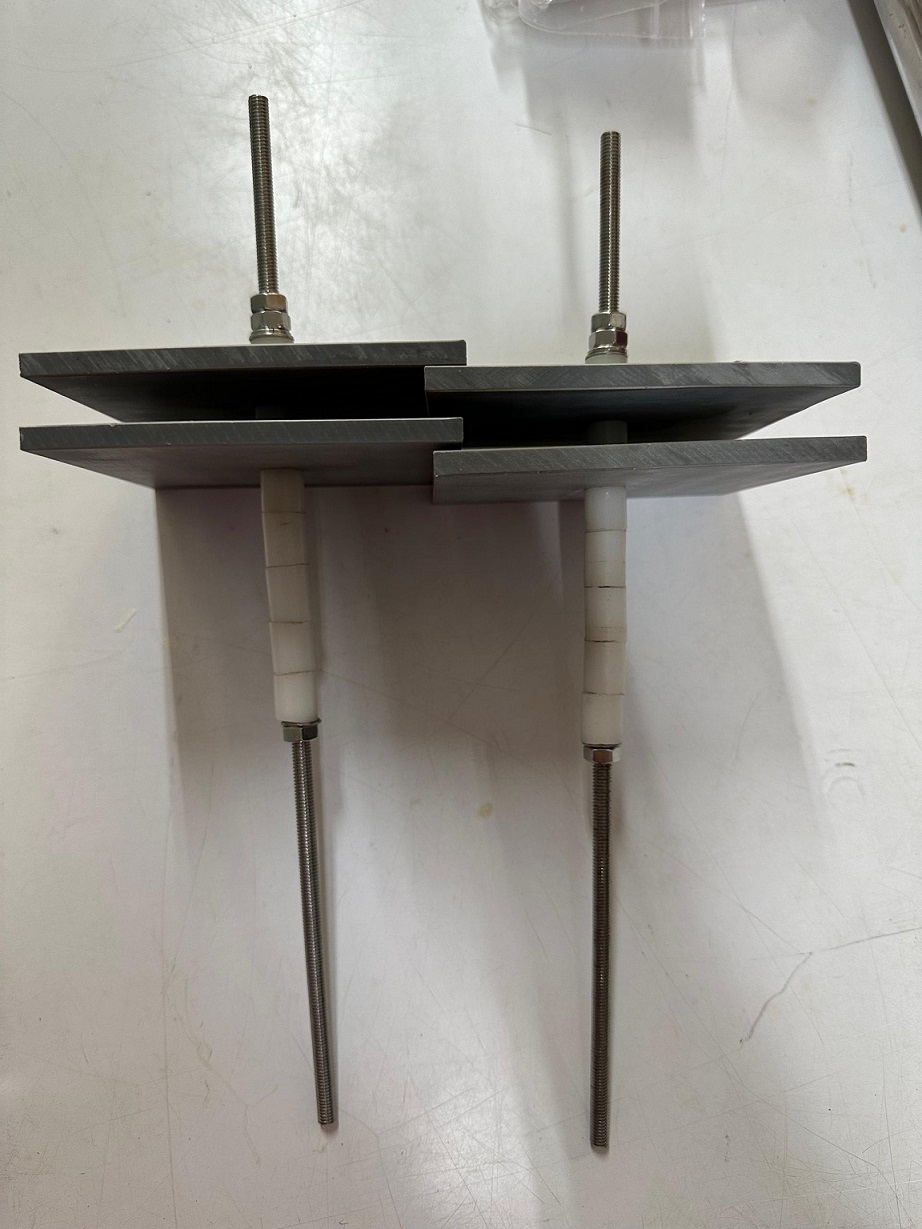
CAUs provide a standardized and cost-effective method for measuring net calcium carbonate accretion and the recruitment of sessile benthic organisms.
Each unit is constructed from a pair of sanded PVC settlement tiles separated by a spacer, designed to simulate a range of natural reef microhabitats – exposed surfaces, shaded overhangs, and cryptic spaces.
This allows for the recruitment of diverse calcifying and non-calcifying taxa and enables quantification of both community structure and functional accretion rates.
Deployment of Calcification Accretion Units
On Feb 2, 2023, 12 CAUs were deployed along the reef slope fronting Merc at depths ranging from seven to 14 metres.
These depths were selected to reflect natural habitat gradients in coral reef zones and provide representative data for Sabah’s reef environments.
Two CAUs were successfully retrieved on July 17, 2025 for preliminary analysis, which is currently in progress at Cemacs.
This increase in acidity is unequivocally due to the oceans’ absorption of excess carbon dioxide from the atmosphere generated by human activities.
Large numbers like 30pc increase in ocean acidity since pre-industrial days mean that ocean acidification is accelerating globally but is experienced most strongly in coastal areas where local processes tend to exacerbate the phenomenon.
The only station in South China Sea to track issue, thanks to friends
So Sabah is really very privileged and proud that the sole monitoring station on ocean acidification in the South China Sea is located at its prime coastal sea at Gaya Island right opposite its flourishing capital city, Kota Kinabalu.
This joint effort among close friends combines the use of Calcification Accretion Units (CAUs) with an environmental data logging to assess reef ecosystem function, resilience, and early indicators of change.
CAUs provide a standardized and cost-effective method for measuring net calcium carbonate accretion and the recruitment of sessile benthic organisms.
Each unit is constructed from a pair of sanded PVC settlement tiles separated by a spacer, designed to simulate a range of natural reef microhabitats – exposed surfaces, shaded overhangs, and cryptic spaces.
This allows for the recruitment of diverse calcifying and non-calcifying taxa and enables quantification of both community structure and functional accretion rates.
Deployment of Calcification Accretion Units
On Feb 2, 2023, 12 CAUs were deployed along the reef slope fronting Merc at depths ranging from seven to 14 metres.
These depths were selected to reflect natural habitat gradients in coral reef zones and provide representative data for Sabah’s reef environments.
Two CAUs were successfully retrieved on July 17, 2025 for preliminary analysis, which is currently in progress at Cemacs.
 The retrieved samples are undergoing image-based taxonomic assessment and decalcification to separate calcified and non-calcified biomass – an essential step in calculating site-specific accretion rates and comparing them with regional benchmarks.
Hourly records of temperature and light intensity
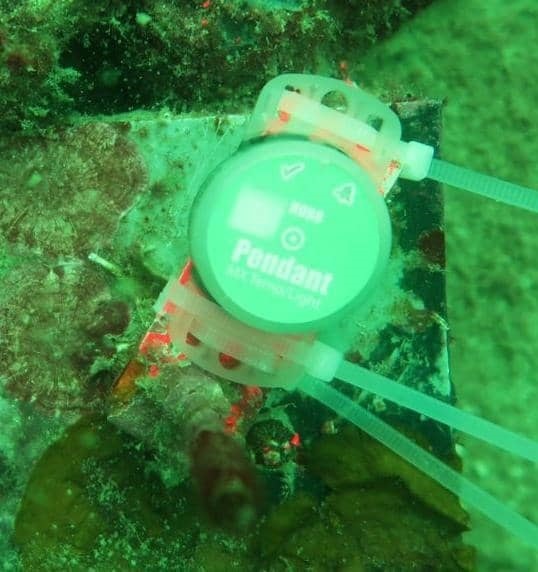
To complement biological assessments, environmental parameters have been continuously monitored using an Onset MX2202 Hobo Pendant® MX Temperature/Light Data Logger placed at the CAU site.
This instrument records hourly temperature and light intensity and is retrieved and replaced every one to two months for maintenance and data extraction.
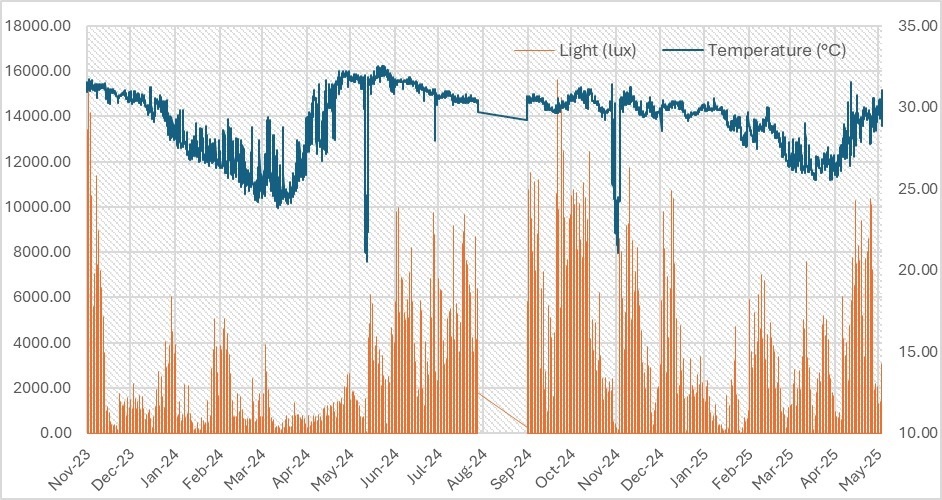
Between Nov 4, 2023 and May 6, 2025, the logger collected a total of 12,345 records.
Water temperature ranged from a minimum of 20.55°C to a maximum of 32.56°C, with a mean of 29.12°C and a standard deviation of 2.07°C.
These values indicate typical seasonal fluctuations in a tropical marine environment, with elevated temperatures observed during late inter-monsoon periods.
The data distribution showed a slight positive skew, suggesting prolonged warm conditions with occasional brief cooling events, possibly linked to localised mixing or upwelling.
What light intensity data reveals
Light intensity data revealed a highly variable pattern, ranging from 0 lux during night time to a maximum of 15,610.88 lux under full daylight.
The mean light intensity was 730.63 lux, with a large standard deviation of 1,627.16 lux.
The retrieved samples are undergoing image-based taxonomic assessment and decalcification to separate calcified and non-calcified biomass – an essential step in calculating site-specific accretion rates and comparing them with regional benchmarks.
Hourly records of temperature and light intensity
To complement biological assessments, environmental parameters have been continuously monitored using an Onset MX2202 Hobo Pendant® MX Temperature/Light Data Logger placed at the CAU site.
This instrument records hourly temperature and light intensity and is retrieved and replaced every one to two months for maintenance and data extraction.
Between Nov 4, 2023 and May 6, 2025, the logger collected a total of 12,345 records.
Water temperature ranged from a minimum of 20.55°C to a maximum of 32.56°C, with a mean of 29.12°C and a standard deviation of 2.07°C.
These values indicate typical seasonal fluctuations in a tropical marine environment, with elevated temperatures observed during late inter-monsoon periods.
The data distribution showed a slight positive skew, suggesting prolonged warm conditions with occasional brief cooling events, possibly linked to localised mixing or upwelling.
What light intensity data reveals
Light intensity data revealed a highly variable pattern, ranging from 0 lux during night time to a maximum of 15,610.88 lux under full daylight.
The mean light intensity was 730.63 lux, with a large standard deviation of 1,627.16 lux.
 This broad range is reflective of the dynamic underwater light regime, shaped by diurnal cycles, turbidity, weather, and depth.
The dataset displayed a strong right-skew, indicative of infrequent but intense sunlight exposure amidst longer durations of reduced light – conditions that directly influence photosynthetic organisms and, by extension, reef calcification rates.
Critical context for interpreting biological trends
Together, these environmental parameters provide critical context for interpreting biological trends observed in the CAUs.
Extended exposure to elevated temperatures combined with fluctuating light availability may influence recruitment success, metabolic rates, and the overall composition of early benthic communities.
As the CAU sample analysis progresses, integration of biological and environmental data will allow for a more comprehensive understanding of the conditions driving reef growth or decline at this site.
This collaborative monitoring initiative by CEMACS and MERC underscores the importance of institutional partnerships in generating high-quality, long-term data for coral reef management.
By combining expertise in marine ecology, field operations, and analytical techniques, the programme establishes a strong foundation for understanding the responses of Sabah’s reefs to changing ocean conditions.
The integration of biological and environmental monitoring ensures that the outcomes of this work will be relevant not only to local reef conservation strategies but also to broader regional and global efforts in climate adaptation and marine biodiversity assessment.
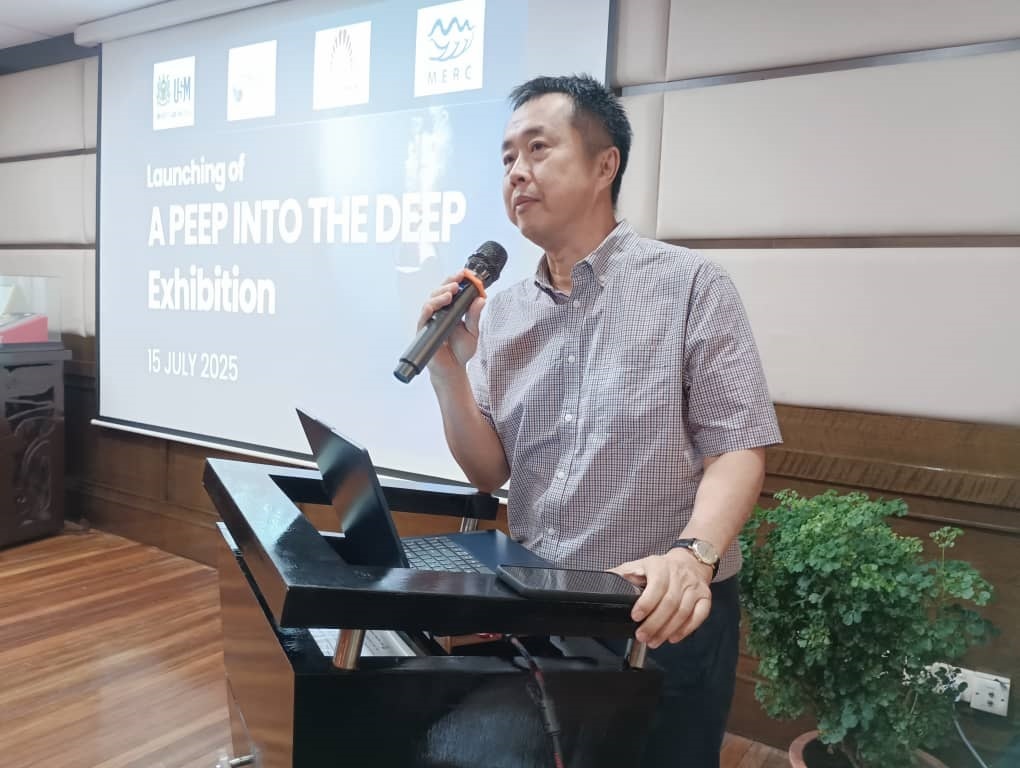
Marine Ecology Research Centre Project Director and aquatic biologist, Alvin Wong, said: “The Ocean Acidification Monitoring project is a milestone which started at our Giant Clam Propagation Project in late 2006 for restocking and from that it has led to something bigger.”
“Being the only monitoring station in South China Sea, the data collected over the last two years and the years to come would be important for policy makers and scientists globally.”
This broad range is reflective of the dynamic underwater light regime, shaped by diurnal cycles, turbidity, weather, and depth.
The dataset displayed a strong right-skew, indicative of infrequent but intense sunlight exposure amidst longer durations of reduced light – conditions that directly influence photosynthetic organisms and, by extension, reef calcification rates.
Critical context for interpreting biological trends
Together, these environmental parameters provide critical context for interpreting biological trends observed in the CAUs.
Extended exposure to elevated temperatures combined with fluctuating light availability may influence recruitment success, metabolic rates, and the overall composition of early benthic communities.
As the CAU sample analysis progresses, integration of biological and environmental data will allow for a more comprehensive understanding of the conditions driving reef growth or decline at this site.
This collaborative monitoring initiative by CEMACS and MERC underscores the importance of institutional partnerships in generating high-quality, long-term data for coral reef management.
By combining expertise in marine ecology, field operations, and analytical techniques, the programme establishes a strong foundation for understanding the responses of Sabah’s reefs to changing ocean conditions.
The integration of biological and environmental monitoring ensures that the outcomes of this work will be relevant not only to local reef conservation strategies but also to broader regional and global efforts in climate adaptation and marine biodiversity assessment.
Marine Ecology Research Centre Project Director and aquatic biologist, Alvin Wong, said: “The Ocean Acidification Monitoring project is a milestone which started at our Giant Clam Propagation Project in late 2006 for restocking and from that it has led to something bigger.”
“Being the only monitoring station in South China Sea, the data collected over the last two years and the years to come would be important for policy makers and scientists globally.”
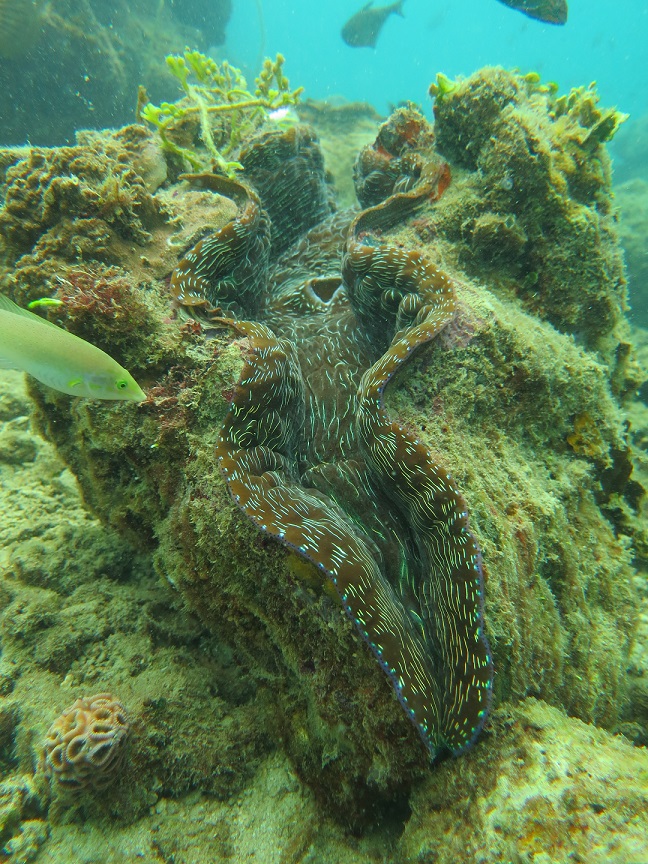
 Interestingly, over the last 20 years, the Marine Ecology Research Centre (MERC) has accumulated a stock of 120 mature giant clam broods which are located at the shallower sea bed near the Ocean Acidification Monitoring Station.
“Actually, the triple threats of ‘Hotter, Sour and Breathless’ oceans are all adverse to giant clams,” Alvin noted.
In 2010, MERC was recognised by the Malaysia Guinness Book of Records for being the first to have successfully bred all seven species of giant clams found in Malaysian waters.
Editor’s note: The facts in the Special Report are contributed by Prof Dato’ Dr Aileen Tan Shau Hwai, a prominent figure in marine science who is the Director of Centre for Marine and Coastal Studies, Universiti Sains Malaysia. As recent as June 30 this year, she was awarded the Anton Bruun Medal – one of the most prestigious Unesco international recognitions for significant contribution to the world of marine science, The Medal is awarded every second year by the Intergovernmental Oceanographic Commission (IOC) at its Biannual Assembly but only when there is a candidate deemed worthy. IOC is a body within Unesco.
Interestingly, over the last 20 years, the Marine Ecology Research Centre (MERC) has accumulated a stock of 120 mature giant clam broods which are located at the shallower sea bed near the Ocean Acidification Monitoring Station.
“Actually, the triple threats of ‘Hotter, Sour and Breathless’ oceans are all adverse to giant clams,” Alvin noted.
In 2010, MERC was recognised by the Malaysia Guinness Book of Records for being the first to have successfully bred all seven species of giant clams found in Malaysian waters.
Editor’s note: The facts in the Special Report are contributed by Prof Dato’ Dr Aileen Tan Shau Hwai, a prominent figure in marine science who is the Director of Centre for Marine and Coastal Studies, Universiti Sains Malaysia. As recent as June 30 this year, she was awarded the Anton Bruun Medal – one of the most prestigious Unesco international recognitions for significant contribution to the world of marine science, The Medal is awarded every second year by the Intergovernmental Oceanographic Commission (IOC) at its Biannual Assembly but only when there is a candidate deemed worthy. IOC is a body within Unesco.